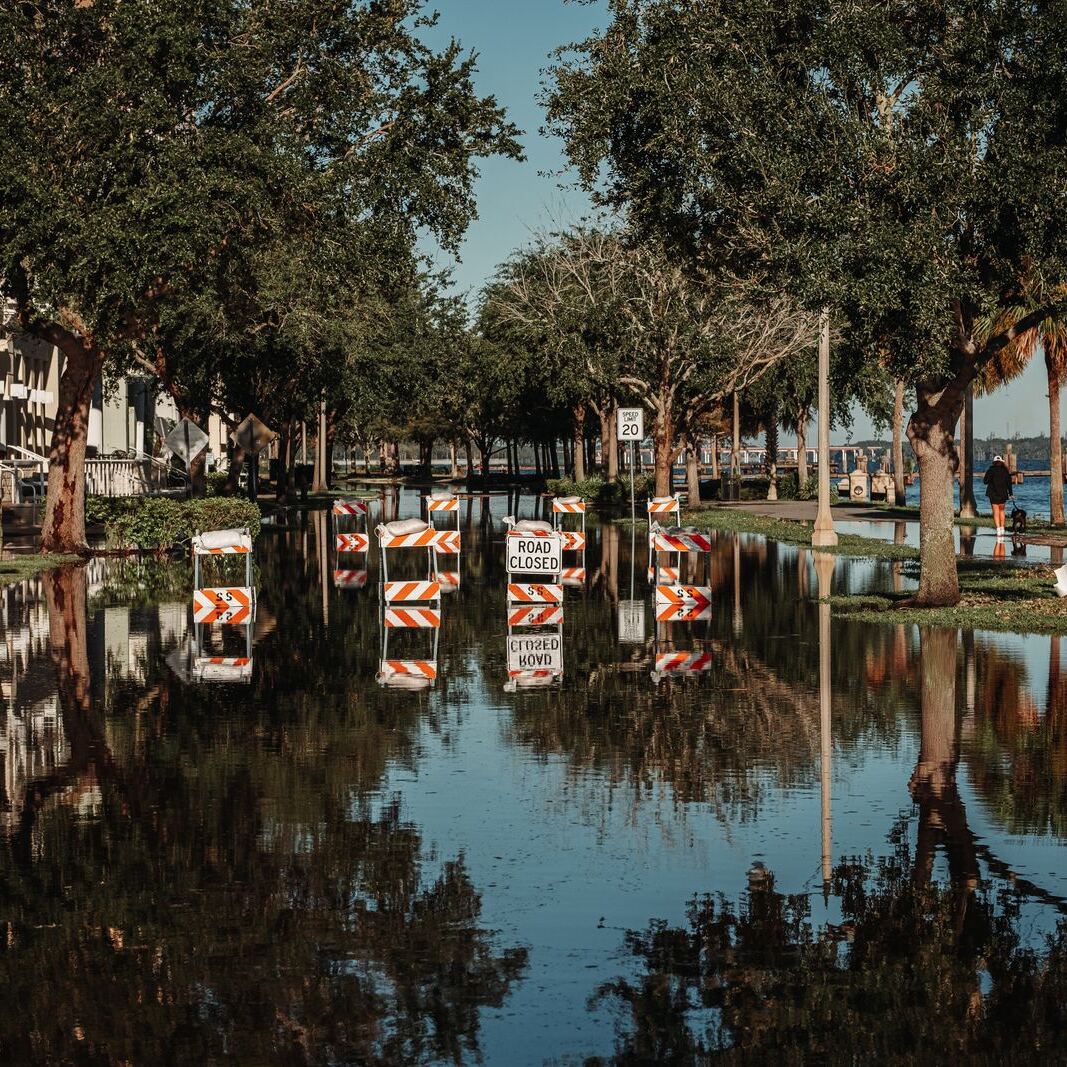

Homeowners insurance in North Carolina does not cover flood damage. The Department of Insurance says so in its first sentence on the subject, and adds: "Just because your home is not in a designated flood plain, do not assume you will never incur flood damage."[1] Flood coverage is a separate policy, from the National Flood Insurance Program (NFIP) or a private insurer. An NFIP policy covers a home up to $250,000 on the building and $100,000 on contents and usually takes effect 30 days after you buy it.[3] The private flood policy approved for North Carolina has no waiting period.[2]
This guide is for a North Carolina homeowner, buyer or renter deciding whether to buy flood insurance and which kind. Our flood insurance page lists what we need to quote, and our North Carolina page shows the coverages we quote in the state today.
Is flood insurance required in North Carolina?
No state law requires it. The Department of Insurance says "your lender may require flood insurance if your home is located in a flood plain."[1] If you own the home outright, or it sits outside the mapped floodplain, the decision is yours.
The Department urges owners near a river, in a floodplain or near the coast to consider it, and not to read a low-risk zone as no risk.[1] Its flood conference FAQ makes the same point more bluntly: "If it rains where you live, you may need flood insurance," and properties in lower risk zones may qualify for lower-cost policies.[2]
How do NFIP and private flood policies compare in North Carolina?
The Department's FAQ lists how the private flood policy approved for North Carolina differs from the NFIP policy.[2] Set beside FEMA's own description of the NFIP, the comparison looks like this.
| NFIP policy | Private policy approved for North Carolina | |
|---|---|---|
| Waiting period | 30 days after purchase, with four exceptions[3] | None[2] |
| Home limits | Up to $250,000 building and $100,000 contents[3] | Set by each company, so higher limits may be available[2] |
| Deductibles | Building and contents are usually bought separately, with separate deductibles[3] | One deductible[2] |
| Living expenses while you are out of the home | Not covered: temporary housing and additional living expenses are among the things the policy doesn't protect[3] | Additional living expenses and loss of use are covered[2] |
| Replacement cost | Available for fewer properties[2] | Available for more properties[2] |
| What counts as a flood | Inundation of two or more acres or two or more properties[2] | No two-property or two-acre requirement[2] |
| Regulator | FEMA | The North Carolina Department of Insurance[2] |
The FAQ adds that private rating "is more precise, and in many cases the premium is lower than the NFIP premium."[2] That is the Department's general statement, not a promise about your address. Not every insurer offers the private policy everywhere, so compare both for your home. Our NFIP vs private cost guide explains how each is priced.
When does coverage start?
For an NFIP policy, 30 days after the date of purchase. FEMA lists four exceptions:[3]
- No wait if you buy flood insurance while making, increasing, extending or renewing a mortgage.
- No wait if you change your coverage while renewing your policy.
- One day if your property is in a newly designated high-risk flood zone and you buy within 12 months of the map update.
- One day if a flood is caused or worsened by a wildfire on federal land and you buy within 60 days of the containment date.
The Department's advice follows from that: "Don't wait until a storm is approaching to purchase coverage."[1] If you are buying a home, the Department's FAQ says coverage can start on the date of closing when the mortgage company requires it.[2]
What does flood insurance cover, and what does it leave out?
It covers damage from flood as the policy defines it: overflow of inland or tidal waters, unusual and rapid accumulation or runoff of surface water, mudflow, and collapse of land along a shore from erosion caused by waves or currents above normal levels.[2] The federal program also covers flood-related mudslide and erosion.[1]
Three limits matter in North Carolina:
- Mudflow is covered, landslide is not. Mudflow is "a river of liquid and flowing mud." A landslide or slope failure, when the land crumbles, is not covered by flood insurance even if the ground is wet. The Department calls this a key reason to consider flood insurance for property on a slope.[2]
- Basements get limited coverage. If all four walls of an area are below grade, it is a basement. Equipment that services the home, such as a water heater or sump pump, is covered as part of the building. Most contents there aren't, apart from a few items such as a washer and dryer.[2]
- Wind and water are separate claims. A burst pipe or rain through a storm-damaged roof belongs to the homeowners policy. Rising water belongs to the flood policy. After a hurricane, adjusters use eyewitness accounts, weather reports and the damage itself to divide the two.[2]
How do I find my flood zone?
North Carolina runs its own mapping site. The Department points owners to the state's Flood Risk Information System at fris.nc.gov, which gives the flood zone and base flood elevation, to FEMA's Map Service Center, and to the state's flood inundation mapping network for rivers and streams.[2] An elevation certificate, prepared by a licensed surveyor, can also affect the price.[2] Our guide to zones AE and X explains what the letters mean.
NFIP coverage is sold in communities that take part in the program. The Department's FAQ says the vast majority of North Carolina communities participate, and that 28 did not as of June 2020.[2]
Have the property address, the year built, the foundation type, whether there is a basement or enclosure and any elevation certificate ready, then start a flood quote.
Frequently asked questions
Does homeowners insurance cover flood in North Carolina?
No. The Department of Insurance states that homeowners insurance policies do not cover flood damage.[1]
Can renters buy flood insurance?
How long before a hurricane do I need to buy?
Is a landslide covered by flood insurance?
No. Mudflow is covered; a landslide or slope failure is not, even when the land is wet.[2]
What if my home is worth more than $250,000?
The NFIP building limit for a home is $250,000.[3] A private policy may offer higher limits, and excess flood insurance sits above an NFIP policy.
This guide is for educational purposes. It summarizes the North Carolina Department of Insurance's flood insurance page and its flood conference FAQ, which is dated 2020, and FEMA's National Flood Insurance Program page, all read on November 19, 2026. Naming the private flood policy here doesn't mean it is available for your property or that Menlo places it. Your policy's terms, conditions and endorsements control. Menlo Insurance Services is a licensed property and casualty agency in North Carolina that may earn a commission on a placement.
The Bottom Line
In North Carolina, flood is never part of the homeowners policy.[1] The NFIP gives you up to $250,000 on the building and $100,000 on contents after a 30-day wait; the private policy the state approved drops the wait and adds living expenses, where an insurer offers it.[2][3] Look up the address on the state's flood maps, compare both, and buy before the forecast turns.
References
- 1.North Carolina Department of Insurance. “Flood Insurance.” Accessed 2026-11-19. https://www.ncdoi.gov/consumers/homeowners-insurance/flood-insurance ↩
- 2.North Carolina Department of Insurance. “FAQs from the NC Department of Insurance Flood Conferences.” 2020. https://www.ncdoi.gov/faqs-2020-ncdoi-flood-conferences/open ↩
- 3.FEMA National Flood Insurance Program (FloodSmart). “Buy a policy.” Accessed 2026-11-19. https://www.floodsmart.gov/get-insured/buy-a-policy ↩