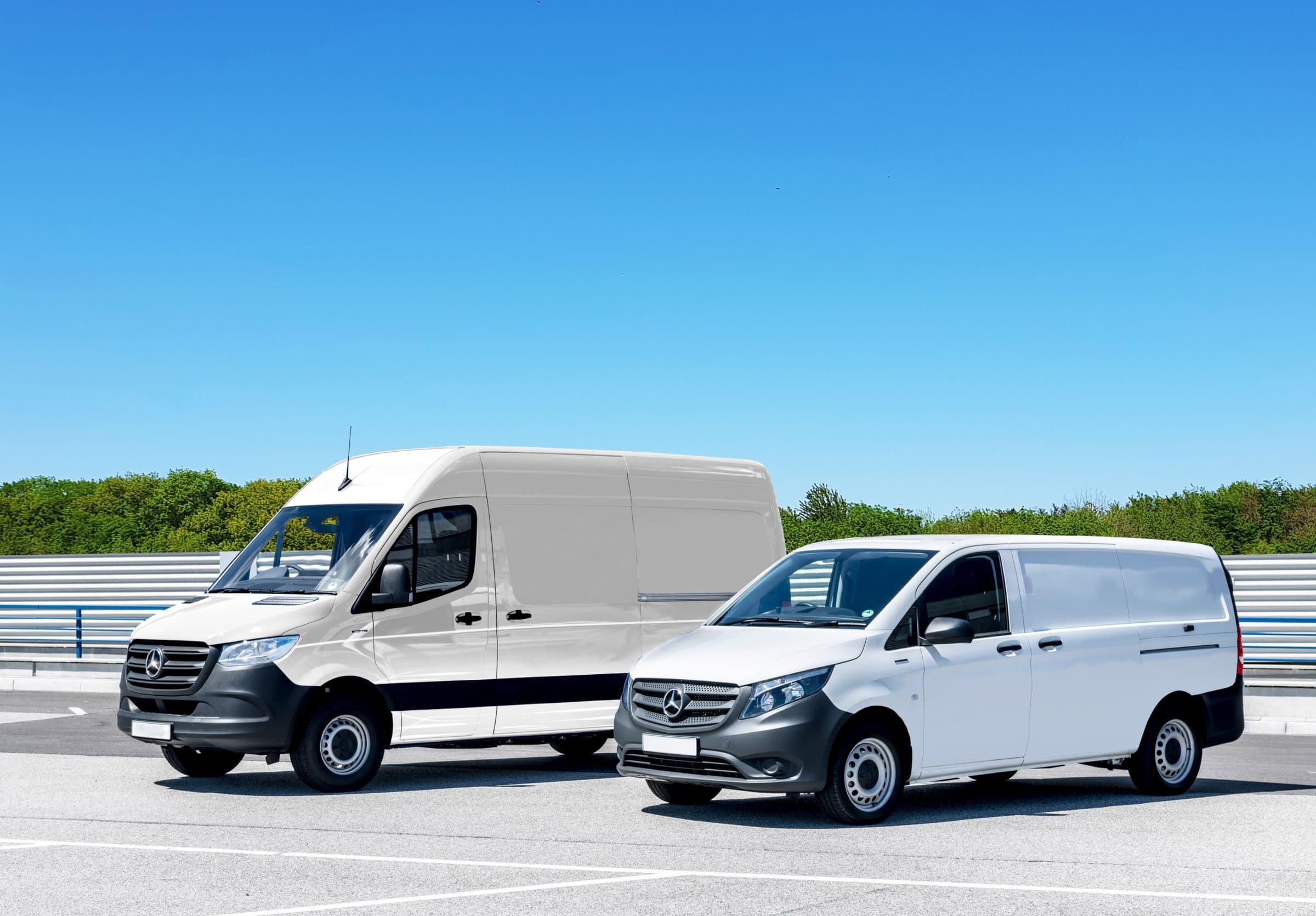

Every business vehicle in California is required to carry at least the state's minimum liability, which rose to $30,000 per person, $60,000 per accident and $15,000 for property damage for policies issued or renewed on or after January 1, 2025.[1] A truck with two or more axles over 10,000 pounds gross vehicle weight rating, or any vehicle that carries property for pay, makes your business a motor carrier of property. That requires a DMV motor carrier permit and an insurance certificate filed with the DMV showing a combined single limit of at least $750,000, or $300,000 if you only operate vehicles under 10,000 pounds.[2][3][4]
This guide is for a California business owner with work vehicles: a contractor's pickups, a caterer's van, a landscaper's truck and trailer, or a small delivery fleet. It explains which rules apply to which vehicles, what a business auto policy adds over a personal one, what limits your clients may ask for and which small-business insurers write it. When you're ready, request a commercial auto quote.
What are California's minimum limits for business vehicles?
The same floor as for personal autos. For policies issued or renewed on or after January 1, 2025, Vehicle Code section 16056 requires a minimum of $30,000 for injury to one person, $60,000 for injury to two or more people and $15,000 for property damage in any one accident.[1] Before 2025 the minimum limits were 15/30/5.[1]
That minimum is rarely enough to protect a business. An accident in a work truck can easily exceed $60,000, and your business is responsible for whatever the policy doesn't pay. The Department of Insurance notes that business auto policies are usually written with a combined single limit, with "$500,000 or $1,000,000" common.[6] Most contracts that mention auto liability ask for $1,000,000.
When does my business need a motor carrier permit?
When you operate a "commercial motor vehicle" under the Vehicle Code. That includes any motortruck with two or more axles over 10,000 pounds gross vehicle weight rating, and "any other motor vehicle used to transport property for compensation."[2] Certain vehicles are excluded from this definition, such as certain pickups and two-axle rental trucks under 26,001 pounds used noncommercially.[2]
A motor carrier of property cannot operate on a California highway without a valid motor carrier permit issued by the DMV.[3] The permit is issued only after proof of insurance is filed, and the certificate cannot be cancelled on less than 30 days' written notice to the department.[5] The required limits:
| Motor carrier of property | Minimum liability (Vehicle Code 34631.5) |
|---|---|
| General freight and most carriers | $750,000 combined single limit[4] |
| Operates only vehicles under 10,000 lbs GVWR, no petroleum or hazardous loads | $300,000[4] |
| Petroleum products in bulk and hazardous materials | Higher limits set in the same section[4] |
The rule reaches the people who hire you. A business may not contract with a motor carrier of property that lacks a valid permit, and a carrier that subcontracts its hauling must obtain a certification of compliance from the carrier it hires.[3]
Interstate carriers also have federal filing rules. Our guide to the MCS-90 endorsement explains the federal endorsement, and our motor truck cargo guide covers the freight itself.
What does a business auto policy cover that a personal policy doesn't?
It is written around how a business uses its vehicles. In the Department of Insurance's words, a business auto policy "has the flexibility to provide coverage for business, personal, non-owned, or hired autos," and each auto can be "separately scheduled along with corresponding coverages."[6] A vehicle is classified by weight (light, medium, heavy, extra heavy) and by use (private passenger, service, commercial), and those classifications drive the rate.[6]
The coverage for each vehicle is set by numbered covered-auto symbols. Symbol 1 covers any auto for liability, and narrower symbols cover only owned, scheduled, hired or non-owned autos. Our guide to commercial auto symbols explains each one.
Two gaps catch small businesses:
- Employees driving their own cars on errands. Their personal policy responds first, but a lawsuit names your business too. Hired and non-owned auto coverage protects the business.
- A vehicle titled to the owner but used for the business. Tell the insurer how it's used, because use and ownership decide which policy applies.
Which insurers write small business auto in California?
Commercial auto splits by what you drive and haul. THREE, Berkshire Hathaway's small-business policy, provides commercial auto for businesses in its target segments such as auto services, contractors and landscaping, but lists transportation among the industries it doesn't write.[7][8] For-hire trucking and delivery fleets are submitted to transportation specialists, which we do by hand.
What insurers ask for any business auto quote:
- Each vehicle's year, make, model, VIN, GVWR and garaging ZIP code.
- What each vehicle does: service calls, hauling your own tools and materials, deliveries, or hauling for others.
- The radius of operation.
- Each driver's license number and driving record.
- Prior insurance and five years of claims.
- The limits and certificate wording your contracts require.
How can a small business lower its commercial auto cost?
Start with the drivers. Driving records are one of the strongest rating factors, so check each driver's record before adding them. Then:
- Schedule only the vehicles the business actually uses, with accurate use and radius.
- Choose physical damage deductibles you can afford, and drop collision on old vehicles worth little.
- Keep a written policy on who may drive and on personal use.
- Report and document every accident promptly.
Frequently asked questions
What is the minimum commercial auto insurance in California?
Do I need a motor carrier permit for my pickup truck?
Usually not, if the pickup is rated at 10,000 pounds GVWR or less and carries only your own tools and materials, not property for pay. The permit applies to commercial motor vehicles, which include motortrucks of two or more axles over 10,000 pounds GVWR and any vehicle used to carry property for compensation.[2]
Does my personal auto policy cover a vehicle I use for work?
It may not fully cover business use. Tell your insurer how the vehicle is used. A business auto policy can schedule the vehicle with coverages matched to that use.[6]
What limit should my business carry?
Business auto policies commonly carry $500,000 or $1,000,000 combined single limits, and most contracts ask for $1,000,000.[6]
This guide is general information based on the California Vehicle Code and Department of Insurance material current in 2026. Your policy's terms and your contracts control. Menlo Insurance Services (CA license 6020106) is a licensed broker that may earn a commission on a placement.
References
- 1.California Legislative Information. “Vehicle Code section 16056.” Accessed 2026-09-27. https://leginfo.legislature.ca.gov/faces/codes_displaySection.xhtml?sectionNum=16056.&lawCode=VEH ↩
- 2.California Legislative Information. “Vehicle Code section 34601.” Accessed 2026-09-27. https://leginfo.legislature.ca.gov/faces/codes_displaySection.xhtml?sectionNum=34601.&lawCode=VEH ↩
- 3.California Legislative Information. “Vehicle Code section 34620.” Accessed 2026-09-27. https://leginfo.legislature.ca.gov/faces/codes_displaySection.xhtml?sectionNum=34620.&lawCode=VEH ↩
- 4.California Legislative Information. “Vehicle Code section 34631.5.” Accessed 2026-09-27. https://leginfo.legislature.ca.gov/faces/codes_displaySection.xhtml?sectionNum=34631.5.&lawCode=VEH ↩
- 5.California Legislative Information. “Vehicle Code section 34630.” Accessed 2026-09-27. https://leginfo.legislature.ca.gov/faces/codes_displaySection.xhtml?sectionNum=34630.&lawCode=VEH ↩
- 6.California Department of Insurance. “Commercial Insurance Guide (Form 700, revised June 14, 2024).” Accessed 2026-09-27. https://www.insurance.ca.gov/01-consumers/105-type/95-guides/09-comm/commercialguide.cfm ↩
- 7.THREE by Berkshire Hathaway. “Target Industries.” Accessed 2026-09-27. https://www.dropbox.com/scl/fi/2xs8qqoep4ikzbl1w6px7/THREE-s-Target-Industries.pdf?rlkey=8acznhbtbu9p4h0pbb88yx62m&st=0g7ir7dn&e=2&dl=0 ↩
- 8.THREE by Berkshire Hathaway. “Common Declines (last updated May 1, 2026).” Accessed 2026-09-27. https://www.dropbox.com/scl/fi/1r2bp7b8cjc29ec0t9m24/Common-Declines_THREE.pdf?rlkey=x2ecusadw2qojb09ow6ohy66g&st=qivtg7kb&e=1&dl=0 ↩